Your floors are working against you right now, and you might not even know it. Every rain season that passes, every morning of salty coastal air, every wet boot tracked across the wrong stuff is quietly doing damage beneath the surface, damage that doesn’t reveal itself until the boards have cupped, the finish has lifted, and replacement is the only option left on the table. In the Pacific Northwest, choosing the wrong flooring is not a one-time mistake; it is an expensive commitment that compounds silently over the years, and by the time it becomes visible, the cost of fixing it far outweighs what the right material would have cost from the start.
At Silver Bo Stone LLC, we have spent over 24 years helping homeowners across Bainbridge Island choose flooring that is built to handle exactly what this climate delivers, year after year.
This blog covers everything you need to know about wood-look tile flooring; what makes it work, why it outperforms hardwood in wet climates, what most people get wrong during installation, and how to choose the right style for your home.
What Is Wood-Look Tile Flooring?
Wood-look tile flooring is tile flooring designed to mimic the look of real hardwood, grain texture, knot patterns, and color variation, using high-definition inkjet printing technology. The best products use Embossed-in-Register (EIR) technology, where the tile’s physical surface texture aligns precisely with its printed grain. Run your hand across a quality porcelain wood plank tile, and you feel the grain exactly where you see it.
Manufactured in long, narrow plank formats, typically 6” to 9” wide and a minimum of 36” long, these tiles are specifically created to mimic the proportions of real wood boards.
Why Bainbridge Island Homes Are Perfect for Wood-Look Tile
Tile flooring for coastal homes is a direct response to physics. Here is what the Pacific Northwest climate does to real hardwood over time: wood fibers absorb ambient moisture and expand, then contract as conditions dry. This cycle, repeated season after season, causes cupping, gapping and surface cracking.
The salt air on the coast accelerates the deterioration of the finish as well. In high humidity areas, to maintain hardwood, you must keep indoor humidity between 30–50% at all times – even when you are away, which means running climate control constantly just to protect your floor.
Porcelain tile absorbs less than 0.5% of water. It does not expand, contract, cup, or warp. For Bainbridge Island homeowners, water-resistant wood tile flooring is not a workaround; it is the more intelligent original choice.
Wood-Look Tile vs. Hardwood Flooring: Which Is Better for Island Living?
| Factor | Wood-Look Tile | Real Hardwood |
| Moisture tolerance | Near waterproof (≤0.5% absorption) | Absorbs moisture; warps over time |
| Salt air resistance | Unaffected | Degrades finish and fiber |
| Climate control required | None | Indoor humidity must stay 30–50% |
| Refinishing needed | Never | Every few years |
| Long-term maintenance cost | Low | High |
| Resale impact | Strong — buyers value durability | Risk-dependent in wet climates |
As a hardwood alternative flooring in the PNW, wood-look tile wins on practicality without sacrificing visual warmth. Selected and installed properly, it can provide measurable value to a home, making wood-look tile resale value a real and well-documented benefit to island homeowners.
If your floor needs a dehumidifier to survive winter, it was never the right floor to begin with.
Best Materials for Wood-Look Tile Flooring: Porcelain vs. Ceramic
Both are clay-based, but the manufacturing difference matters significantly. Higher firing temperatures make porcelain denser, tougher, and far less porous, the clear standard for the best flooring for wet climate Washington conditions. It has a Mohs hardness of 7–8 and satisfies all the needs of a coastal home with no special maintenance.
Ceramic works well for interior rooms with lighter foot traffic and lower moisture exposure. It costs less and is easier to work with during installation, but it does not match porcelain’s performance in the environments where Bainbridge Island homes need it most.
Porcelain wood plank tile is the baseline recommendation for kitchens, bathrooms, entryways, or any room that regularly sees moisture, not an upgrade.
Top Design Styles That Work in Bainbridge Island Homes
The Pacific Northwest has its own design language, one that leans into natural textures, layered tones, and materials that feel earned rather than decorated. Low-maintenance flooring on Bainbridge Island has to do more than look good on day one; it has to age well in a home that lives hard and sees real weather.
- Coastal Farmhouse is one of the most popular directions we see in island homes; light, whitewashed, or grey-washed planks that carry visible grain without being loud about it. This tone works particularly well alongside stone countertops and soft white interiors, and it opens up kitchen and living spaces without making them feel cold.
- Pacific Northwest Modern takes the opposite approach. Deep walnut and espresso-toned planks with tight, nearly invisible grout lines create a floor that anchors a room with quiet confidence. This style rewards homes with strong natural light, the darker tone absorbs it rather than competing with it, and the result feels intentional rather than heavy.
- Rustic Island Cabin draws from the landscape itself, warm amber and brown tones with hand-scraped surfaces that suggest reclaimed wood and slow-built character. Whether the home looks out onto Douglas firs or the Puget Sound, this direction fits without forcing.
Best Rooms to Install Wood-Look Tile Flooring in Your Home
Wood-grain tile bathroom and kitchen installations are the most common applications, and the most logical, since these are the two rooms most vulnerable to moisture. But durable flooring for island homes belongs throughout the home:
- Entryways and mudrooms handle rain gear, muddy boots, and wet dogs daily. No material handles this abuse more gracefully than tile.
- Living areas benefit from wide-plank tiles that create a seamless, warm look that real hardwood cannot always sustain in humid conditions.
- Bathrooms achieve a spa-like finish with wood-grain tile while completely eliminating the moisture risk that comes with real wood.
How to Choose the Right Plank Size and Color for Your Space
Plank length matters more than most people realize. Any tile less than 36 inches long just gives it away; real wood planks aren’t that short. The width (often 6″ to 9″) is a matter of proportion; wider planks feel contemporary and expansive, narrower ones work better in traditional or smaller spaces.
Grout color is where most installations succeed or fail. The goal is to make grout lines disappear. Choose a grout tone that closely matches the dominant shade of your tile, warm tan for oak tones, medium grey for weathered-wood styles. But no matter how good the tile quality, a contrasting grout totally shatters the illusion. Use the smallest grout line your tile will allow; rectified tiles can go as small as 1/16”, getting close to the almost seamless look of real hardwood planks.
Tile pattern, plank length, and grout color- get all three right, and no one will know it is not wood. Miss one and everyone will.
Installation Tips for Wood-Look Tile Flooring in Bainbridge Island
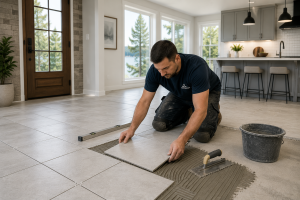
Wood effect porcelain tile installation requires precision at every stage. Before we even lay a single tile, the subfloor has to be level and structurally sound – any flex or unevenness will eventually result in cracked tiles. Plank tiles require full-coverage adhesive underneath, not spot-bonding, which creates hollow voids that fail under regular foot traffic. A random stagger pattern of at least one-third offset mimics the natural variation of real wood and avoids the predictable grid look that reads immediately as manufactured tile.
One detail professionals know that most homeowners do not: because tiles are factory-made, patterns can repeat across a floor. Skilled installers recognize and break up these repetitions deliberately so the finished floor reads as organic rather than uniform. Tile flooring installation on Bainbridge Island should never be where you cut costs in a tile project.
Why Choose Silver Bo Stone LLC for Your Wood-Look Tile Project
A home flooring upgrade in the Pacific Northwest deserves guidance from people who understand both the materials and the climate. At Silver Bo Stone LLC, our team has been serving Bainbridge Island, Bremerton, Silverdale, and the surrounding region for over 24 years. Our owner, Donny, personally specializes in fine stone and tile flooring for indoor and outdoor spaces, and that hands-on expertise runs through every project we take on.
Our 4,000-square-foot showroom in Poulsbo lets you see and feel thousands of tile flooring Bainbridge Island options in one place before committing to anything. We also offer square-foot pricing on select materials so you only pay for what your project needs. We provide the same standard of care with residential, commercial, and multi-family projects from design consultation through final installation.
Your Floor Is a 30-Year Decision: Make It the Right One
Wood-look tile flooring on Bainbridge Island is not simply a style preference; it is a structural decision. In a climate that makes hardwood work against itself, water-resistant wood tile flooring eliminates the problem entirely. The right porcelain wood plank tile, properly installed with correct grout and layout, is virtually indistinguishable from real hardwood and will outlast it by decades in PNW conditions. As an investment in tile flooring, it does what wood flooring can’t do: it maintains its value and alleviates the long-term maintenance burden that coastal homeowners know too well.
At Silver Bo Stone LLC, we bring 24 years of expertise to every tile flooring Bainbridge Island project, from material selection through installation. Whether you are upgrading a single bathroom or replacing floors throughout your home, our team will help you get it right the first time.
Come into our Poulsbo showroom and see what the right floor actually looks like in person. Call (360) 297-4080, and we will take it from there.