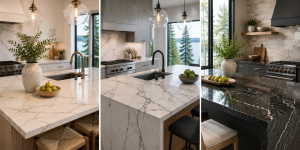
Most kitchen renovations don’t fail because of bad materials; they fail because those materials were never asked to work as a team. A countertop chosen in isolation, cabinets from a catalog, and flooring put in months apart rarely add up to a room that makes sense, no matter how much each piece costs on its own. Silver Bo Stone has spent 24 years correcting exactly this kind of disconnect, one kitchen at a time.
This guide breaks down how to match countertops with cabinets and floors using the same undertone and contrast logic designers rely on, not guesswork. You will learn why some pairings last for decades while others seem dated in just a few years. We’ll also cover the specific mistakes that quietly eat away at a kitchen’s resale value.
Why Coordinating Countertops, Cabinets, and Flooring Matters
Coordination is not a design preference but a structural principle having to do with how the eye processes a room. Designers refer to visual noise as when countertops, cabinets, and flooring are all going in different directions. And the effects of that noise go beyond appearances.
The 60-30-10 Rule Applied to Kitchens.
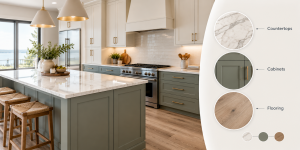
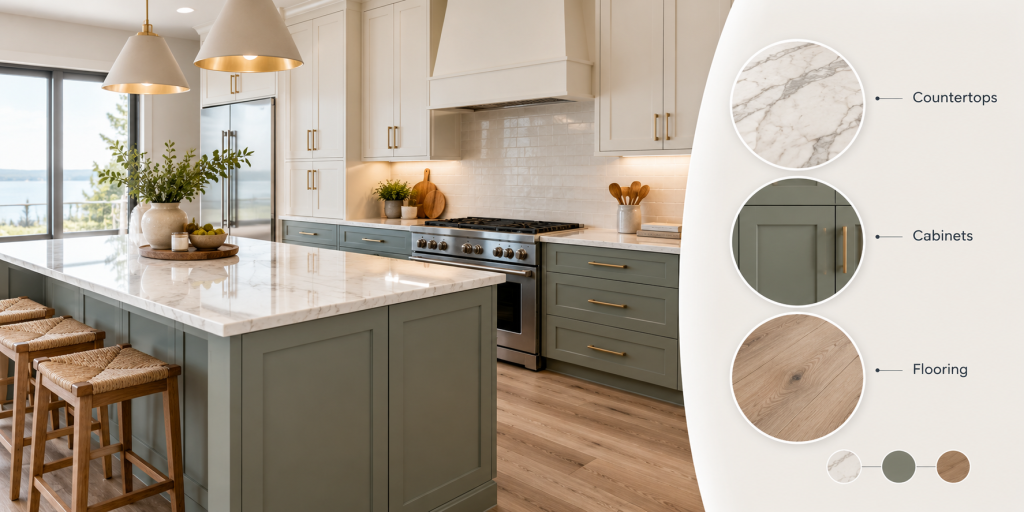
Designers generally break down a room’s palette in three ratios: 60% dominant, 30% secondary, and 10% accent. In a kitchen, cabinets are usually the main act, countertops are the supporting players, and flooring or tile is the accent. Kitchens that ignore this ratio, where countertop and cabinet compete for equal visual weight, tend to feel busy regardless of how expensive the materials are. Viewing kitchen design cohesion through this lens turns color decisions into math instead of guesswork.
How Mismatched Finishes Affect Resale Value
Real estate agents consistently flag inconsistent kitchen finishes during walkthroughs because it signals a rushed renovation rather than a planned one. Do countertops and floors need to match precisely? No. But if they clash in undertone, buyers register the disconnect within seconds, even if they can’t explain why. Left uncorrected, a mismatched kitchen forces the next owner into a second renovation instead of a simple cosmetic refresh, a cost most sellers would rather avoid passing on.
Start with a Design Anchor: Choosing Your Base Element First
Before you select finishes, determine which surface will determine your design decisions. It is that one choice which makes all the rest fall easily into place.
- Flooring-first: The practical route when existing floors are staying, and everything else needs to adapt around them
- Cabinet-first: The standard approach in full remodels, since cabinetry occupies the most visual real estate in the room
- Countertop-first: The right call when a specific slab, with distinctive veining or color, sparked the renovation in the first place
The most common reason that homeowners reselect materials halfway through a project is that they skip this step.
Matching Countertop Colors with Cabinet Finishes
Cabinet countertop flooring combinations hinge on one variable more than any other: contrast. The difference between cabinet colors and countertop colors determines if a kitchen reads as bold, balanced, or just busy.
Light Countertops with Dark Cabinets
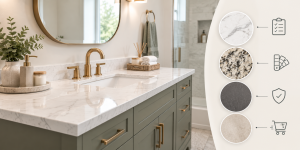
Light countertops against dark cabinets provide definition, and that contrast makes small kitchens feel larger by drawing the eye out instead of boxing it in. This is still one of the most popular countertop and cabinet color pairings, especially with quartz or light granite with subtle gray or beige flecking.
Dark Countertops with Light or White Cabinets
The reverse pairing carries its own logic. Deep charcoal, soapstone-grey, or black countertops are a great grounding weight beneath white or off-white cabinets, grounding a kitchen that otherwise might feel flat. It’s a common answer to what color countertop goes with dark cabinets in reverse: pale cabinetry paired with a dark, low-maintenance stone.
Monochromatic Pairings for a Seamless Look
Choosing countertops and cabinets in the same tonal family creates a calm, cohesive look, but only if texture is providing the contrast color typically would. Without the movement of veined stone countertops or a shift between honed and polished finishes, a monochromatic kitchen can read as unfinished rather than intentional.
A kitchen with the right cabinet-countertop contrast photographs well from day one; a kitchen without it usually needs a second renovation within a decade.
Coordinating Countertops with Flooring Tones
Countertop and flooring coordination follows a stricter rule than cabinet pairing, because floors sit under natural light all day and reveal undertone shifts that overhead lighting tends to hide.
Warm Wood Flooring with Cool-Toned Countertops
Cool-toned countertops like gray or blue-grey quartz will go well with warm wood floors with amber or honey undertones. The cooler stone offsets the heat below so the room doesn’t turn all orange in the afternoon light.
Cool-Toned Flooring with Warm Countertop Materials
Grey-washed wood or a light porcelain tile is a cool flooring options that need a warmer countertop material, such as a beige granite or gold-veined marble, to avoid a sterile feel. This is the most dependable way to choose flooring that matches countertops without either surface reading as cold.
Matching Undertones for a Cohesive Palette
Flooring and countertop undertones are easiest to compare using light reflectance value, or LRV, a grading scale that measures how much light a surface bounces back. Two materials of the same color family can clash badly if their LRVs are far apart, which you can’t tell from a sample chip alone.
| Flooring Undertone | Best Countertop Undertone | Example Pairing |
| Warm (golden, honey) | Cool or neutral | Honey oak floors + grey quartz |
| Cool (grey, ash) | Warm or neutral | Grey plank floors + beige granite |
| Neutral (greige) | Warm or cool | Greige tile + white marble or dark g |
An undertone mismatch is often invisible on a sample chip and impossible to ignore once the room is finished.
Mixing Textures and Patterns Without Overwhelming the Space
Veined stone, wood grain, and cabinet texture can coexist in the same kitchen, but only when one material is allowed to lead. It is the most regrettable issue after installation because it is the hardest to detect in a showroom compared to color problems.
The Rule of One Dominant Pattern
Let the boldest material, usually the countertop, set the visual pace, and keep flooring and cabinetry quieter by comparison. A busy quartzite, a heavily grained wood floor, and a patterned tile backsplash compete for attention in three different directions, destroying kitchen design consistency, even if each material is beautiful on its own.
Why Scale Matters as Much as Color
Large-format veining reads differently at a distance than up close, which is why a slab that looks stunning on a small sample can overwhelm an entire countertop run once installed. It’s the scaling of the pattern to the room’s size, not only the color palette, that prevents a finished kitchen from looking chaotic.
Popular Color Combinations for Hansville Homes
Hansville’s coastal setting calls for palettes that feel relaxed rather than showroom-perfect. A neutral color scheme kitchen built around soft blues, sandy beiges, and driftwood tones tends to outlast trend-driven choices.
- Coastal: white cabinets, blue-grey countertops, light wood flooring
- Neutral: greige cabinets, warm granite countertops, natural oak flooring
- Natural: wood-tone cabinets, veined stone countertops, stone-look tile flooring
Kitchen color scheme matching becomes far simpler once a direction like one of these is chosen, and each kitchen color palette here holds up under the Pacific Northwest’s shifting light.
Using Samples and Lighting to Test Combinations Before You Commit
Natural light and material selection are inseparable, and skipping this step is where most mismatches actually start, not in the showroom, but at home under different light.
Why Color Temperature Changes Everything
Overcast days in Hansville are cooler than the warm light many showrooms simulate with incandescent bulbs. (Light is measured in Kelvin.) A countertop that appears warm and inviting in showroom lighting can look gray and lifeless under the typical cloud cover of the Puget Sound.
The 24-Hour Test
The best way to do sample board testing is to leave the samples in the actual kitchen for a minimum of 24 hours, checking them in the morning, midday, and evening. This single step spots undertone conflicts that a five-minute showroom visit rarely does.
Common Mistakes to Avoid When Matching Materials
Almost every mismatched kitchen we’re asked to fix after the fact has some common mistakes.
- Choosing too much contrast, so nothing in the room feels connected
- Clashing undertones between warm wood and cool stone
- Ignoring existing fixtures, like faucets or lighting finishes, that also need to coordinate
- Selecting materials under showroom lighting instead of the kitchen’s own light
Avoiding these is central to how to coordinate kitchen finishes successfully; correcting them after installation is far more disruptive than getting them right the first time.
Working with a Designer or Contractor in Hansville
At Silver Bo Stone, our team has spent 24 years walking Hansville homeowners through exactly this kind of decision, using a showroom built for side-by-side comparison rather than guesswork. When people see granite, marble, and quartz samples together, away from artificial lighting, they change how confidently they choose.
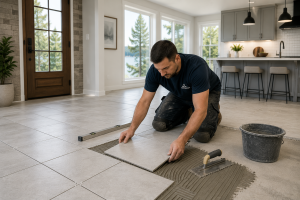
We also handle residential tile installation for kitchens and bathrooms, including kitchen tile installation in Kingston and bathroom tile installation that Kingston homeowners rely on for full renovations. Whether you already know your direction or need guidance from the ground up, our team can walk you through options built to last, not just options that look good on day one.
Final Thoughts: Creating a Timeless, Cohesive Kitchen Look
Matching countertops with cabinets and floors comes down to a short list of decisions: choose a design anchor, weigh undertones over color alone, and let one material lead the texture instead of three materials competing. Kitchens that follow this order last. If you skip this in your kitchen, you’ll usually need a second, more expensive repair in a few years.
Silver Bo Stone brings 24 years of hands-on experience to every project, offering granite, marble, quartz, and tile for kitchens and bathrooms across Hansville and the surrounding region. Our showroom is built specifically so homeowners can compare countertops, cabinet samples, and flooring finishes side by side, under real lighting, before committing to anything permanent.
If you’re ready to match countertops, cabinets, and flooring the right way the first time, contact our team at (360) 297-4080 to schedule a design consultation.